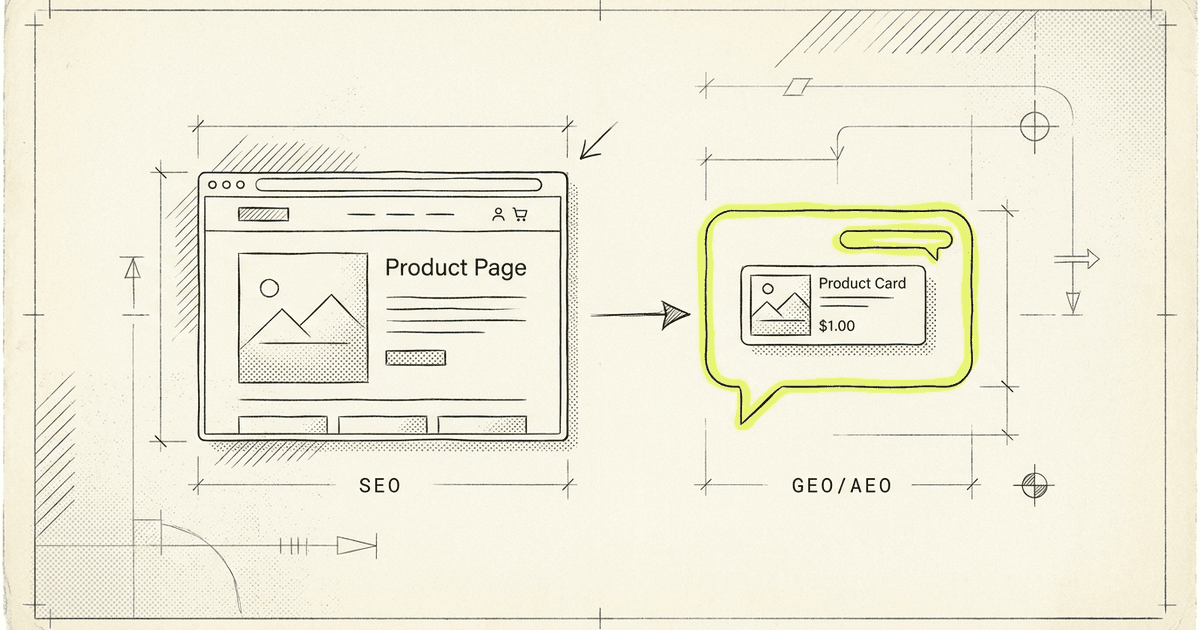
The shift is already happening: According to Capgemini's January 2025 research across 12 countries, 58% of consumers now use generative AI tools instead of traditional search engines for product recommendations—up dramatically from 25% in 2023. Adobe Analytics reports that traffic from AI sources to retail sites grew 1,200% between July 2024 and February 2025, doubling every two months since September 2024. This isn't a future trend—it's the present reality.
And if your brand doesn't have a conversational presence, you're invisible. This represents the next major platform shift in ecommerce, following the same patterns we've seen with mobile and social commerce.
The Search Revolution We Didn't See Coming
For two decades, we optimised for Google. We learned SEO, paid for ads, fought for rankings, created content strategies around keywords and backlinks. The entire ecommerce playbook was built on the assumption that discovery starts with a search bar.
That assumption is breaking down faster than most brands realise.
According to Pew Research (June 2025), 34% of US adults have used ChatGPT, with global usage reaching 800 million weekly active users. Perplexity launched "Buy with Pro" in November 2024 and saw explosive adoption. Google itself is racing to make Gemini the primary interface. Amazon is pushing Rufus as the new way to shop.
The pattern is clear: AI agents are becoming the new starting point for product discovery and purchase decisions.
And these agents don't crawl your website looking for keywords. They don't rank pages based on backlinks. They have conversations about what customers need, then recommend products based on context, relevance, and the information brands make available to them.
How AI Shopping Actually Works
Let's walk through what's happening when someone uses ChatGPT or Perplexity to shop:
Traditional Search (Google): ``` User types: "best waterproof hiking boots" Google returns: 10 blue links to articles and product pages User clicks through multiple sites, compares options, reads reviews Eventually makes a purchase decision (maybe) ```
AI Agent Shopping (ChatGPT/Perplexity): ``` User asks: "I need waterproof hiking boots for multi-day treks in Scotland. My feet get cold easily and I have wide feet. What should I get?"
AI agent:
- Understands context (Scotland weather, multi-day hiking, specific needs)
- Considers multiple factors (waterproofing, insulation, fit)
- Accesses product information from various sources
- Provides specific recommendations with explanations
- Answers follow-up questions
- Facilitates purchase directly or sends to specific product pages
User makes purchase decision in a single interaction ```
The difference isn't just convenience—it's fundamentally different economics. In the traditional model, Google captured value through ads. Multiple sites competed for traffic. Brands paid to be visible.
In the AI model, the agent becomes the trusted advisor. It doesn't send customers to Google results—it provides answers. The brands that are discoverable to these agents capture the demand. Those that aren't don't exist.
The Traffic Patterns Tell the Story
Adobe Analytics tracks over 1 trillion retail site visits annually. Their data reveals the magnitude of this shift:
During the 2024 holiday season, traffic to retail sites from generative AI-powered chatbots increased by 1,300% year-over-year, with Cyber Monday seeing the biggest growth at 1,950% YoY. Beyond the holiday period, Adobe's March 2025 report shows traffic from AI sources grew 1,200% between July 2024 and February 2025—a seven-month period during which the channel doubled every two months since September 2024.
AI-sourced visitors aren't casual browsers. They're informed, intentional, and closer to purchase. This is the most valuable traffic you can get—if you can get it at all.
The Discoverability Problem
Here's where most brands have a blind spot: AI agents don't discover products the way Google does.
Google crawls HTML, follows links, indexes pages, ranks based on signals like backlinks and content quality. Your traditional SEO playbook works because you're optimising for how Google sees the web.
AI agents discover products through:
- Structured data feeds (product catalogues in AI-friendly formats)
- Conversational endpoints (APIs that understand natural language queries)
- Merchant programs (direct partnerships with AI platforms)
- Context-rich descriptions (not just spec sheets, but use cases and benefits)
- Real-time information (inventory, pricing, availability)
If your product information exists only as traditional web pages, you're invisible to AI shopping agents. They need structured, conversational access to your catalogue.
The "Content Theft" Risk
This is where it gets uncomfortable for brands: AI agents can scrape your website's product information without sending you customers.
Traditional Google model:
- Google indexes your content
- Sends you traffic
- You capture the customer and relationship
AI agent model (without brand participation):
- Agent scrapes your product specs and descriptions
- Uses your content to train recommendations
- Recommends competing products that ARE conversationally available
- You get nothing
There's a real risk that brands become involuntary content providers for AI agents that then recommend competitor products. Your expertise, your product descriptions, your photography—all used to inform conversations that send customers elsewhere.
The only defence is participation. Brands that actively provide conversational access to their products control how they're represented. Those that don't risk having their information extracted and their customers redirected.
This is why understanding the difference between chatbots and true conversational UI is critical—you need real conversational infrastructure, not just another chatbot widget.
Why Brands Need Their Own AI Representative
Think about what happens in these AI conversations:
Customer to ChatGPT: "I'm looking for natural skincare products for sensitive skin that are reef-safe and cruelty-free."
Without brand AI representative: ChatGPT synthesizes information from various sources, makes general recommendations, may or may not mention your products accurately, and you have no influence over the conversation.
With brand AI representative: Your conversational UI provides accurate, comprehensive information about your products, their benefits, how they meet specific needs, availability, and purchase options. You're actively represented in the conversation, not passively mentioned.
This isn't about advertising. This is about being present in the conversation where purchase decisions are made.
Physical retail figured this out centuries ago—you need sales associates who represent your products knowledgeably. Online retail figured this out with Google—you need SEO to be discoverable.
Conversational commerce requires the same principle: you need an AI representative that participates in shopping conversations.
The Perplexity Merchant Program Model
Perplexity's approach reveals where this is heading. Their Merchant Program allows brands to:
- Share product specifications directly
- Ensure AI has access to accurate, current information
- Increase likelihood of recommendations
- Track which queries drive interest
- Optimise product representation for AI discovery
This is the blueprint. Major AI platforms are building similar programs because they want to facilitate commerce, not just provide information. They need brands to participate actively.
But here's the catch: participating in every AI platform's merchant program individually is unsustainable. You need infrastructure that works across platforms—a conversational UI that can serve ChatGPT, Perplexity, Google Gemini, Amazon Rufus, and whatever comes next.
The Agentic Commerce Protocol Opportunity
OpenAI and Stripe's Agentic Commerce Protocol (ACP), released in September 2025, represents the standardization of AI shopping. When ACP goes mainstream:
- AI agents can transact directly with merchant systems
- Customers complete purchases without leaving AI interfaces
- Brands need standardized ways to expose products and capabilities
- Payment infrastructure handles transactions transparently
This is the endgame: AI agents become primary shopping interfaces. Not supplementary, not experimental—primary.
Brands with conversational UI infrastructure will plug into ACP seamlessly. Those without will need to scramble to build compatibility or risk exclusion from this massive channel.
The Window Is Now
The challenge with platform shifts is recognizing them while you can still capture early-mover advantages. By the time it's "obvious" to everyone, the window has closed.
Consider where we are:
- AI shopping traffic doubling every two months
- Major platforms (OpenAI, Google, Amazon, Perplexity) all racing to facilitate AI commerce
- Capgemini data showing 58% global adoption of AI for product recommendations
- Standardized protocols (ACP, MCP) emerging
This is the inflection point. The brands that move now establish positions while competition is limited. Those that wait face mature channels with established competitors.
What Your Brand Actually Needs
Let's be specific about the infrastructure requirements:
For Human Customers:
- Conversational UI on your website
- Intent understanding and context management
- Product discovery through natural language
- Guidance and recommendations
- Seamless transaction capability
For AI Shopping Agents:
- Structured product data in conversational formats
- Real-time inventory and pricing feeds
- Semantic product understanding
- Standard interfaces for AI agents to interact
- Secure authentication and authorization
- Transaction capability
- Analytics and tracking
This is infrastructure, not marketing content. You can't just write better product descriptions and hope AI agents find you. You need actual conversational infrastructure.
The Dual Interface Requirement
Here's what brands are slow to realize: you need conversational UI for both humans AND AI agents.
Your human customers want to shop conversationally on your site. AI shopping agents want to query your products conversationally to make recommendations to their users.
The same infrastructure serves both:
- Customer visits your site → Engages with your conversational UI directly
- Customer uses ChatGPT → ChatGPT queries your conversational endpoints → Recommends your products
Without this infrastructure:
- Human customers get static website experience
- AI agents can't access your products effectively
- You're invisible in both contexts
The Economics of AI Shopping
Let's talk about what this means financially:
Current CAC (Customer Acquisition Cost):
- Paid search: €15-50 per customer
- Social ads: €20-60 per customer
- Display advertising: €30-80 per customer
AI Discovery Economics:
- Organic discovery through AI recommendations: €0 direct cost
- Infrastructure cost: €99-2,000/month depending on scale
- Qualified traffic from AI sources
- No cost per click, no bidding wars, no ad fatigue
The channel economics are compelling—if you're discoverable. If you're not, the economics are infinite (you don't exist in this channel at all).
What Amazon Knows That You Don't
Amazon is investing heavily in Rufus, their AI shopping assistant. Why? Because they understand that AI agents will become the primary interface for product discovery.
But here's what's crucial: Amazon wants that agent to keep customers on Amazon. When someone asks Rufus for product recommendations, Amazon's goal is to keep the entire transaction within their ecosystem.
For independent brands, this creates a strategic question: Do you want to be discoverable only within Amazon's walled garden, or do you want to be discoverable across all AI shopping assistants?
Having your own conversational UI infrastructure means you're not dependent on Amazon (or any single platform) for AI discoverability. You're available to ChatGPT, Perplexity, Google Gemini, and whatever emerges next.
The Content Ownership Advantage
Here's another strategic benefit of having your own AI representative: you control the conversation.
When AI agents scrape your website for information, they interpret and synthesize that content through their own models. You have no control over how you're represented.
When you provide conversational endpoints, you're actively participating in how your products are described, which questions get answered, which features get emphasized, which recommendations get made.
This matters enormously for brand positioning, product differentiation, and competitive advantage. Your AI representative can:
- Emphasize your unique value propositions
- Explain why your products are different
- Provide context that spec sheets don't capture
- Guide customers to the right products for their needs
- Maintain brand voice and positioning
Without this, you're passively mentioned. With this, you're actively represented.
The Regulatory Angle (Especially in EU)
There's also a data sovereignty element here that matters, particularly for EU brands:
When AI agents scrape your website and use that data to train recommendations, you have:
- No control over data processing
- No GDPR compliance guarantees
- No transparency into how data is used
- No ability to request deletion or modification
When you provide conversational infrastructure as a data processor:
- You control what data is shared
- You maintain GDPR compliance
- You have audit trails and accountability
- You can update or remove information
This matters for compliance and risk management, especially as regulations around AI data usage continue to evolve.
The Technical Reality: This Requires Infrastructure
Let me be direct about something: you can't fake this with better product descriptions.
Some vendors will try to sell you "AI optimization" services that amount to rewriting your product pages with more keywords. That's not what AI agents need.
They need:
- Vector search capabilities to match natural language to products
- Real-time inventory and pricing feeds
- Context engines to understand what customers need
- Semantic product understanding beyond basic specifications
- Integration with your ecommerce backend
- Analytics to optimize recommendations
This is infrastructure work, not content marketing. It requires the same commitment as your initial ecommerce platform build—because it's equally fundamental to your business.
The Competitive Landscape Is Forming Now
Here's the uncomfortable truth: in two years, being conversationally discoverable will be table stakes. Every major brand will have figured this out. The competitive advantage goes to brands who move now while the channel is still emerging.
Consider the parallel to mobile commerce. In 2010, having a mobile-optimized site was differentiating. By 2015, it was expected. By 2020, it was mandatory. The brands that moved early captured disproportionate benefits during those 5-10 years when mobile was still emerging.
AI shopping follows the same pattern, but faster. The traffic growth (doubling every two months) suggests we're on an even steeper adoption curve than mobile was.
Making the Strategic Decision
The question facing ecommerce leaders right now: Do we invest in conversational AI discovery now, or wait until it's proven?
Waiting seems safer. But consider what you're risking:
If you wait:
- Traffic from AI sources goes to conversationally-enabled competitors
- Your products become harder to discover as AI agents dominate search
- You miss the early-mover advantages in an emerging channel
- You play catch-up when the technology becomes table stakes
- You have no data or learnings from AI shopping conversations
If you move now:
- You capture traffic from the fastest-growing channel in ecommerce
- You learn how AI shopping behavior works while competition is limited
- You establish relationships with AI platforms (Perplexity, OpenAI, etc.)
- You're positioned when Agentic Commerce Protocol goes mainstream
- You own the infrastructure that becomes critical competitive advantage
The risk-reward calculation clearly favors action.
The Bottom Line
AI agents are replacing search engines as the starting point for product discovery. This isn't speculative—it's measurable, it's growing exponentially, and it's already impacting which brands capture demand.
The brands that will thrive in this new landscape are those that have their own AI representatives—conversational UI infrastructure that makes them discoverable, accurately represented, and capable of facilitating purchases in AI-mediated conversations.
This requires real infrastructure investment. It requires strategic commitment. And it requires action now, not next year.
Your competitors are already invisible to AI agents. The question is whether you want to be invisible too, or whether you want to be the brand that AI shopping assistants recommend.
The agents are already shopping. Make sure they can find you.
Ready to make your brand discoverable to AI shopping agents?
Book a demo to see how conversational UI infrastructure positions you for the AI shopping era.