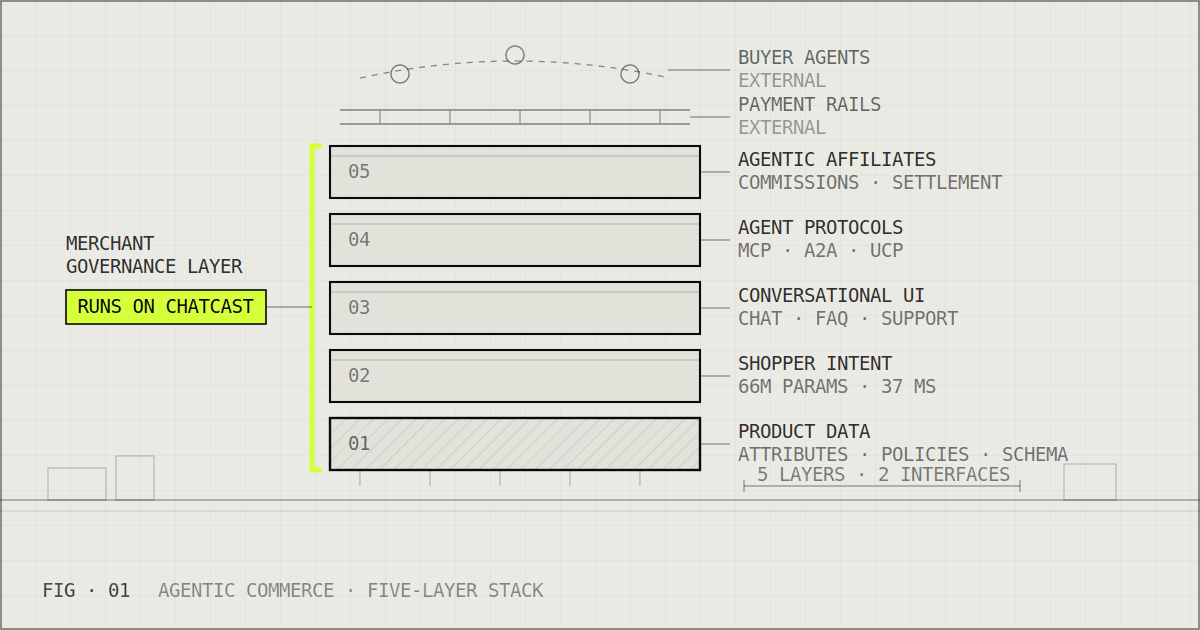
There is a diagram making the rounds that gets agentic commerce more right than most. It stacks the new commerce world into three strata: buyer agents at the top — ChatGPT, Gemini, Perplexity, Claude — acting on behalf of the shopper. Payment rails in the middle — Visa, Mastercard, PayPal, Stripe — authorizing, tokenizing, settling, catching fraud. And then a third stratum: the merchant governance layer — the one that decides what an agent is permitted to offer, to whom, and under what rules.
That third layer is the whole game, and the line underneath it captures why:
Payment rails enable transactions. Merchant governance enables commerce.
A transaction is money moving. Commerce is money moving on your terms — the right product, at a price that protects your margin, to a customer you actually want, under the rules your business runs on. The giants are racing to own the first two layers. The governance layer is the one that decides whether agentic commerce works for the merchant — and it's the one this article is about.
The agentic commerce stack is already being built
This is not a forecast anymore. The top two layers shipped in the last twelve months:
- Buyer agents can now check out. OpenAI launched Instant Checkout in ChatGPT in September 2025, starting with Etsy sellers and expanding toward over a million Shopify merchants including Glossier, Vuori, Spanx and SKIMS. Google followed at NRF 2026 with agentic checkout across Search and Gemini, and Microsoft shipped Copilot Checkout.
- The rails grew agent-aware. Stripe and OpenAI co-published the open Agentic Commerce Protocol (ACP) that powers Instant Checkout. Visa launched Intelligent Commerce in 2025 and later its Trusted Agent Protocol; Mastercard announced Agent Pay with "Agentic Tokens" that bind a card credential to a specific agent, merchant scope, and consent policy.
- A protocol layer formed in the middle. At NRF in January 2026, Google and Shopify unveiled the open Universal Commerce Protocol (UCP) — backed by Amazon, American Express, Etsy, Mastercard, Meta, Microsoft, Salesforce, Stripe, Target, Walmart and Visa — alongside Anthropic's Model Context Protocol (MCP) and the Agent Payments Protocol (AP2).
And the demand is real. Over the 2025 holiday season, Adobe Analytics measured a 693% year-over-year jump in AI-driven traffic to US retail sites, with AI-referred visits converting 31% better than other traffic. Shopify president Harley Finkelstein told investors on the Q4 2025 earnings call that orders from AI searches were up "about 15x" year over year. The 2030 forecasts vary by definition but point the same way: McKinsey projects up to $1 trillion in orchestrated US retail revenue ($3–5 trillion globally), Bain $300–500 billion in US sales, and Morgan Stanley $190–385 billion.
Why governance is the layer that decides who wins
Be honest about where the leverage isn't. You are not going to out-build OpenAI on buyer agents or Visa on payment rails — and you shouldn't try. Universal buyer agents and universal payment rails are good for merchants the way universal shipping and universal credit cards were good for merchants.
But notice what those layers do and don't do. A buyer agent can find your product. A payment rail can charge for it. Neither one knows whether you actually wanted to sell that SKU, at that price, to that shopper, right now. Even the rails' own makers concede this: Stripe describes ACP as letting merchants retain "full control over what's sold, how their brand shows up, and how orders are fulfilled." That control is the governance layer — and the rest of the industry now agrees it's where the action is. commercetools shipped its "Sphere" platform so enterprises "retain full control over the guardrails — the permissions, policies and limits — that govern what every agent is allowed to do." Mastercard launched "Verifiable Intent" as a trust layer; Visa shipped a Trusted Agent Protocol. Governance isn't an afterthought in agentic commerce. It's the layer everyone is converging on.
Here's the part that's specific to you, the merchant. Shopify Catalog now syndicates your products to every connected AI platform by default, and Agentic Storefronts went live for all US merchants in March 2026. That's rails-and-data, handed to you for free. What it does not give you is a layer to govern what those agents are allowed to do with it. The default, absent governance, is that every agent gets the same flat catalog answer — no margin logic, no eligibility rules, no incentive to recommend you over the identical product three stores down. Governance is the layer you own.
Governance is not one thing — and product data alone isn't it
The reason governance is hard is that it isn't a single feature you can bolt on. It's a stack of its own, and each part depends on the one beneath it. Pricing and margin policies. Inventory truth. Offer eligibility. Approval workflows. Loyalty and CRM. A rules engine that ties them together. And underneath all of it, a clean, structured representation of what you actually sell — because you cannot govern what you can't describe.
That structured product data is the core — the foundation everything else reads from. But a feed on its own is not governance. A feed tells an agent what exists; it doesn't tell the agent what it may do. Turning data into governed commerce takes a full ecommerce harness: the intent to know when a rule applies, the skills that define what an agent may do, the policy rules that say what's allowed, the interfaces that apply them to humans and machines alike, and the incentives that set the terms. Which is why Chatcast is built as five parts, not one product.
The five layers that power the governance layer
1. Product Data Enrichment — the core
Everything above reads from it. Chatcast builds and maintains the data layer underneath your store: attributes, policies, embeddings, schema — structured automatically so every part above shares the same ground truth. It's the core of the whole harness, and it's where governance starts: you cannot enforce offer eligibility on products whose attributes are mush, and an agent can't answer "is this gluten-free / in stock in Berlin / returnable" if that fact was never structured. (Read the deep dive →)
2. Shopper Intent — knowing when a rule applies
Our 66M-parameter commerce intent classifier reads what a shopper or an agent is actually trying to do — 13 intent types, 37ms latency, at zero marginal cost per query. Governance rules are conditional by nature ("offer the bundle when the shopper is comparing," "route to support when it's a returns question"). You can't apply a conditional rule until you know which condition you're in. Intent is what turns a pile of policies into the right action.
3. Conversational UI — governance for humans
A brand-trained assistant for human shoppers: chat, dynamic FAQ, recommendations, support — one surface, four skills, your live catalog as ground truth. Most shoppers still arrive on your site, not through an agent, and the same governed data and rules have to express themselves to a human in your brand's voice. The governance layer isn't only for machines.
4. Agent Protocols — governance for machines
A public agent-protocol server — MCP, A2A, UCP, llms.txt, schema.org — so ChatGPT, Perplexity, Claude and Gemini can query your live catalog through one open standard. This is how your governance reaches the agents at all: the surface on which you express "here's what you may offer, and here's how." It's the API of your governance.
5. Agentic Affiliates — governing the terms
Campaigns, commission rates, attribution and settlement for the agentic web: pay AI agents on performance when they bring shoppers to checkout. This is governance's answer to "under what rules" — including the economic ones. The affiliate layer is where the merchant sets terms: who gets paid, how much, for what outcome. It's the difference between agents being able to recommend you and having a reason to.
How Chatcast runs the governance layer
Stack those five up and you have the working machinery of merchant governance: structured truth at the core, intent to know when rules apply, two interfaces to apply them everywhere demand shows up, and an incentive system to set the terms. Chatcast enforces this through a policy engine and agent skills driven by your store's intents — deterministic actions an agent is allowed to take, gated by the rules you set — and keeps that behavior honest with evaluations that check the assistant against your catalog and policies rather than letting a model improvise.
That's the distinction worth holding onto: getting discovered by agents starts with product data, the core. Getting them to sell on your terms takes the whole harness. Payment rails will move the money. Buyer agents will find the products. The question that decides which merchants win is the one those layers don't answer — what are your agents allowed to sell, to whom, and on whose terms? — and that's the layer Chatcast was built to run.
Frequently asked questions
What is agentic commerce?
Agentic commerce is online shopping where AI agents — like ChatGPT, Google's Gemini, Perplexity or Amazon's Rufus — discover, evaluate, and increasingly purchase products on a shopper's behalf, often without the shopper ever visiting the merchant's website. It became transactional in late 2025 when OpenAI and Stripe launched Instant Checkout in ChatGPT.
What are the layers of the agentic commerce stack?
At a high level: buyer agents (the AI doing the shopping), payment rails (Visa, Mastercard, Stripe and protocols like ACP/AP2 that move the money), and the merchant governance layer (what a merchant permits agents to offer, to whom, and under what rules). Chatcast delivers the governance layer through five working parts: product data, shopper intent, a human conversational interface, agent protocols, and an agent-incentive/affiliate system.
What is the "merchant governance layer" in agentic commerce?
It's the policy-and-execution layer that controls how AI agents are allowed to represent and sell your products — pricing and margin rules, offer eligibility, inventory truth, approval workflows, loyalty, and the rules engine that ties them together. Buyer agents and payment rails don't provide it; the merchant owns it. Chatcast runs it through a policy engine, agent skills, and intent routing, validated by evaluations.
Is product data enough to sell through AI agents?
No. Structured product data is the core — agents can't discover or trust products they can't read — but a feed only tells an agent what exists, not what it may do. Selling on your terms also needs intent, skills, policy/governance rules, interfaces, and incentives: the full ecommerce harness on top of the data.
How do I make my products show up in ChatGPT and Google AI shopping?
You need machine-readable, structured product data exposed through the protocols these agents read (schema.org, Google's UCP/Merchant feeds, the Agentic Commerce Protocol, MCP). On Shopify, eligible products are syndicated through Shopify Catalog by default; beyond that, a dedicated agent-protocol layer lets you control exactly what each agent sees and on what terms. (More on the product-data layer →)
Is agentic commerce the same as having an AI chatbot?
No. A chatbot is a single conversational feature. Agentic commerce spans an entire stack — data, intent, interfaces for both humans and machines, governance rules, and incentives — and is as much about machine-to-machine transactions through agents as it is about chat.
How big is the agentic commerce market?
Forecasts vary by definition. By 2030, McKinsey has projected up to ~$1 trillion in orchestrated US retail revenue ($3–5 trillion globally), Bain estimates $300–500 billion in US sales, and Morgan Stanley $190–385 billion. Nearer term, eMarketer estimates AI platforms will drive roughly $20.9 billion in US ecommerce in 2026, rising to $144 billion by 2029.
Chatcast is the agentic commerce infrastructure for ecommerce brands — five layers, two interfaces, one source of truth, and the governance to run it. See how the platform fits together or start free.
Sources
- OpenAI — Buy it in ChatGPT: Instant Checkout and the Agentic Commerce Protocol
- Stripe — Stripe powers Instant Checkout in ChatGPT and releases the Agentic Commerce Protocol
- Salesforce — Support for the Agentic Commerce Protocol with Stripe
- Google Developers — Under the Hood: Universal Commerce Protocol (UCP)
- Google — Sundar Pichai's NRF 2026 remarks
- PYMNTS — Google Debuts 'Universal' Protocol for Agentic Commerce
- Digital Commerce 360 — Visa, Mastercard offer support for AI agents
- Shopify — Agentic Commerce on Shopify: How It Works (2026)
- Shopify — Q4 2025 earnings call transcript (AI-search order growth)
- McKinsey — The agentic commerce opportunity
- Adobe — AI traffic surge to retail sites
- commercetools — Agentic Commerce Stats 2026