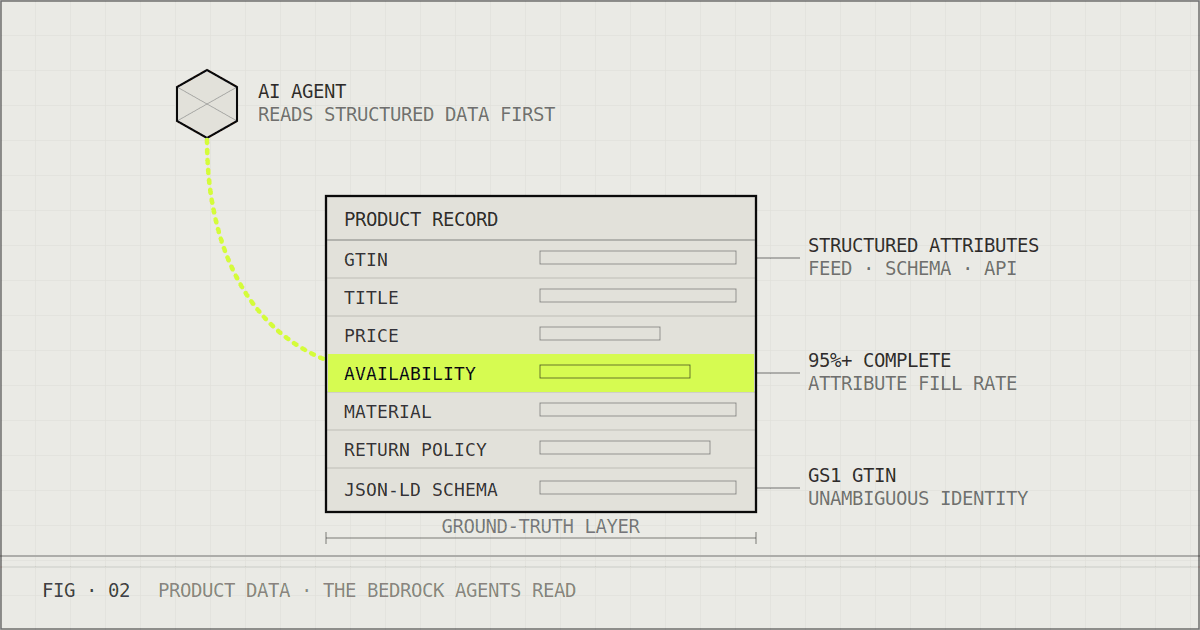
An AI shopping agent cannot sell a product it cannot read. When a shopper asks ChatGPT for "a waterproof running jacket under $150 that ships to Germany," the agent does not browse your beautiful product page the way a human does. It queries structured data — a feed, a schema block, an API — and it answers from whatever fields it finds there. If your jacket's "waterproof" rating lives only in a marketing image, or its German shipping eligibility isn't in the feed, the agent doesn't guess in your favor. It recommends a competitor whose data said yes.
This is the product data layer — the core of the agentic commerce stack. Every layer above it (intent, conversation, agent protocols, incentives) reads from it. Get it wrong and nothing above it can be trusted. Get it right and you become machine-legible to every agent your customers use. But being readable isn't the same as being governed: a feed tells an agent what exists, not what it may do. Data is the core — selling on your terms takes the full ecommerce harness of skills, intent, and policy on top of it.
Why product data is now infrastructure, not an SEO chore
Structured product data used to be a Google Shopping nicety. In the agentic era it became the difference between being discoverable and being invisible. A few things changed at once in 2025–2026:
- The agents read feeds first. Guides to ChatGPT shopping now converge on the same checklist: allow the
OAI-SearchBotcrawler, ship complete JSON-LDProductschema rendered server-side, and reach 95%+ attribute completion in your Google Shopping feed. (Alhena, efulfillment) - Feeds are shared infrastructure. By many accounts, roughly 83% of ChatGPT's shopping carousel data pulls from Google Shopping — meaning the feed you already maintain is quietly powering AI surfaces. (TJ Digital)
- Inconsistency breaks trust. As one optimization guide puts it: "If your schema says a product costs $49.99 but your feed says $54.99, you're going to have problems with AI trust signals." Agents penalize contradictions because they can't tell which number to honor.
The cost of bad data is measurable. A widely-cited survey found 40% of consumers returned an online purchase in the past year because of inaccurate or incomplete product data (Pimberly), and PIM vendors report that disciplined product content can cut cart abandonment by 18–25% (Apimio). Missing attributes don't just hurt human filtering — they remove you from the agent's candidate set entirely. As Akeneo CEO Romain Fouache puts it: "A shopper may now discover, evaluate and purchase your product without ever visiting your website. If your product data isn't complete and consistent, you simply won't show up."
What "good" product data looks like to an agent
Three layers of representation matter, and agents use all of them:
- The feed. A structured product file you push to the AI platform. OpenAI's Agentic Commerce Protocol feed is a compressed JSONL file (the reference format; CSV and XML are also supported) sent to an OpenAI endpoint, and it can be refreshed as often as every 15 minutes for near-real-time price and stock. Google's equivalent is the Merchant Center feed that powers its Shopping Graph. You register at
chatgpt.com/merchantsand Google Merchant Center. (Shopify and Etsy stores are auto-enrolled into ChatGPT's ecosystem; WooCommerce and BigCommerce merchants submit directly.) - The page schema. Complete
schema.org/ProductandOfferJSON-LD on every product page — price, availability, GTIN, ratings, reviews, color, size, material, shipping, and return policy. Schema.org'sActiontypes act as machine-readable "agentic entry points" that tell an agent what your business can do. Pair it with GS1 GTINs for unambiguous product identity. - The attributes themselves. Not just present, but correct, complete, and consistent across feed and page. This is where Product Information Management (PIM) lives.
Who is building this layer
This is one of the most crowded layers of the stack — and the incumbents are racing to relabel themselves for agents:
- Feedonomics standardizes and syndicates product data across Google, Amazon, Walmart, TikTok Shop and hundreds of channels, and launched an "Agentic Commerce Engine" to translate catalog data into agent-readable form and export to multiple standards at once.
- Salsify, Akeneo, Productsup (which raised $70M), Syndigo, Channable, and DataFeedWatch are the PIM and feed-management incumbents, each now shipping "agent-ready" features.
- Platforms are building it natively. Shopify Catalog standardizes billions of products into a universal taxonomy and verifies pricing and inventory in real time. Microsoft shipped a catalog-enrichment agent (public preview) that extracts product attributes from images.
There's even a name forming for the discipline: agentic SEO — optimizing structured data so agents, not just search crawlers, surface and trust your products.
Where Chatcast fits
Most of the tools above optimize a feed — a file you push outward to channels. Chatcast treats product data as the governed ground truth of your store: it builds and maintains attributes, policies, embeddings, and schema automatically, so the same source of truth feeds the human conversational assistant, the agent-protocol layer, and the rules that govern what agents may offer. A feed makes you present in a channel. A governed data layer makes every layer above it — intent, conversation, protocols, incentives — correct. That's the difference between showing up and being trusted.
Frequently asked questions
How do I get my products to show up in ChatGPT?
Submit a structured product feed at chatgpt.com/merchants, allow the OAI-SearchBot crawler in robots.txt, and publish complete schema.org/Product JSON-LD on your product pages. If you're on Shopify or Etsy, your catalog is auto-enrolled; WooCommerce and BigCommerce merchants submit the feed directly. Aim for 95%+ attribute completion and make sure your feed and on-page prices match.
What product data do AI shopping agents actually use?
Agents read your structured product feed (Google Merchant Center / ChatGPT merchant feed), your on-page schema.org/Product and Offer markup, and product identifiers like GTINs. Key fields: title, description, price, availability, GTIN/brand, images, variants (color/size/material), shipping, and return policy.
What is a product feed and what format does ChatGPT use?
A product feed is a structured file listing every product and its attributes. The ChatGPT/Agentic Commerce Protocol product spec accepts JSONL (the reference format), CSV, and Parquet; Google Merchant Center accepts XML, CSV/Sheets, and API. The same well-maintained feed often powers multiple AI surfaces at once.
Why aren't my products being recommended by AI?
Usually because of thin, incomplete, or inconsistent data: missing attributes (so you fail the agent's filters), no structured schema (so the agent can't parse the page), blocked AI crawlers, or price/availability mismatches between your feed and your site (which agents treat as untrustworthy).
Do I need a PIM for agentic commerce?
You need a single, governed source of truth for product data — which is what a PIM (product information management) system provides. Whether that's a standalone PIM, your commerce platform's catalog layer, or an enrichment service depends on catalog size and complexity; the non-negotiable is that attributes are complete, correct, and consistent everywhere agents read them.
What is product data enrichment?
Product data enrichment is the process of filling in, structuring, and standardizing product attributes — descriptions, specs, categories, identifiers, policies — so the catalog is complete and machine-readable. In agentic commerce it's foundational: agents can only represent products as well as the underlying data describes them.
How is product data for AI different from regular SEO?
Traditional SEO optimizes pages for human readers and search rankings. "Agentic SEO" optimizes structured data — feeds, schema, attributes — so AI agents can parse, trust, and act on your catalog. The audience is a machine making a recommendation or a purchase, not a person skimming a results page.
Chatcast builds the governed product-data layer underneath your store — the ground truth every AI agent and every shopper reads from. See how the platform fits together or start free.
Sources
- Alhena — ChatGPT Product Feed: How to Submit & Set Up (2026)
- eFulfillment Service — Product Data Optimization Guide for Google's AI Shopping (2026)
- TJ Digital — Set Up Your Product Feed for ChatGPT and Google AI Shopping (2026)
- Paz.ai — ChatGPT Product Feed: Format and How to Submit
- GitHub — Agentic Commerce Protocol specification
- Akeneo — Why Product Data Is the Foundation of AI-Ready Commerce (Romain Fouache)
- Pimberly — Product Data Quality
- Apimio — Improve Product Data Quality with PIM
- Stellagent — Feedonomics Launches 'Agentic Commerce Engine'
- CB Insights — Productsup raises $70M; PIM competitor landscape
- Shopify — Agentic Commerce on Shopify: How It Works (2026)
- Microsoft — Agentic AI capabilities for retail (catalog enrichment agent)