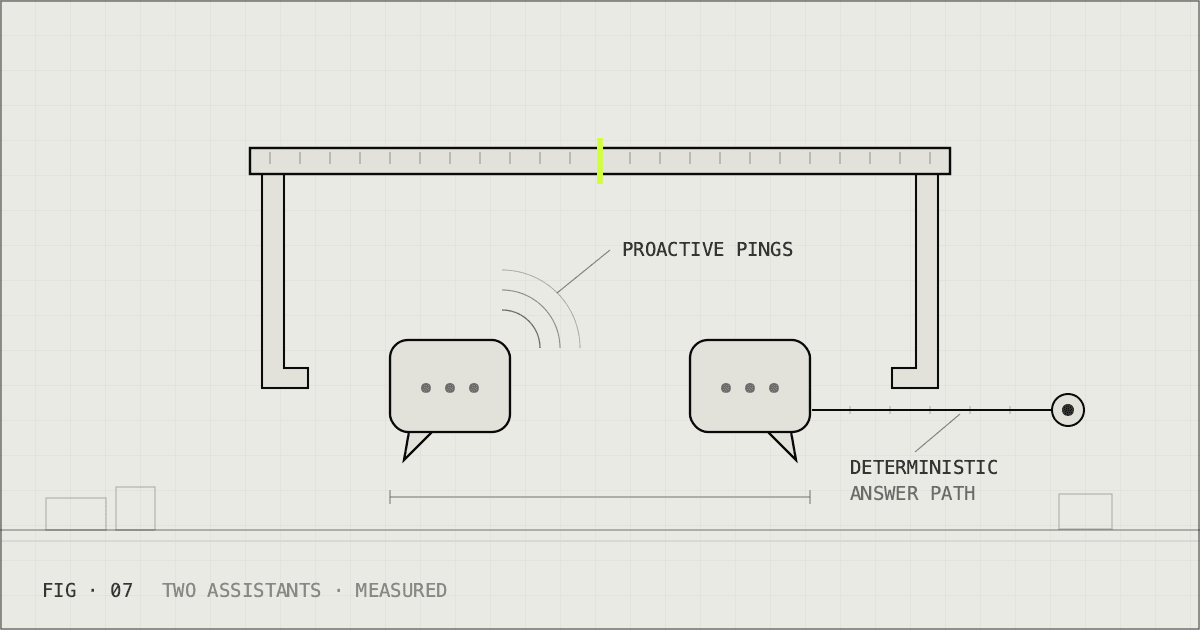
The short version: Chatcast and Rep AI are the two comparisons in this category that actually deserve each other. Both are AI sales assistants built for Shopify. Both exist to convert browsers into buyers, not to deflect support tickets. The difference is where each one concentrates its engineering.
Rep AI's edge is behavioral, on-site engagement: its behavioral AI watches how shoppers move through your store, detects hesitation and exit intent, and starts a conversation at the moment a sale is about to slip away. If your conversion problem is "visitors arrive and leave without talking to anyone," Rep AI attacks that problem directly.
Chatcast's edge is the layer under and beyond the widget: deterministic answers generated from an enriched, structured version of your catalog rather than free-form LLM generation, plus an agentic-commerce stack — a public MCP server, agent affiliate commissions, and automatic data enrichment — that makes your store discoverable and recommendable on surfaces Rep AI doesn't reach: ChatGPT, Perplexity, Claude, and Gemini.
If you want the most aggressive on-site conversion recovery available today, Rep AI is a strong choice. If you want accurate on-site answers and a store that AI agents can find, query, and get paid to recommend, that's what Chatcast was built for. The rest of this post explains both positions fairly, with sources.
What is Rep AI?
Rep AI is an AI sales and support assistant for Shopify, listed on the Shopify App Store as Rep AI: AI Chat & Live Chat. It launched in April 2022, and as of June 2026 it holds a 4.7-star rating across roughly 110 reviews on the App Store — a solid track record for a four-year-old app in a crowded category.
Rep AI's defining feature is its behavioral AI. Rather than waiting passively in the corner of the screen, the system monitors shopper activity in real time — hesitation, repeated product comparisons, exit intent — and initiates a contextual conversation when it detects that a shopper is about to disengage. The pitch is interruption-free rescue: the assistant steps in only when conversion risk appears, rather than firing a popup at everyone.
Beyond drop-off detection, Rep AI's product page describes conversational product search, dynamic recommendations and upsells, configurable sales logic triggered by shopper behavior, and automatic resolution of support questions before they become tickets. The company says it connects with 175+ tools, including Klaviyo and Gorgias, and supports conversations across website chat, email, Facebook, Instagram, and WhatsApp.
Rep AI's homepage now positions the product as "the Agentic Commerce Operating System for brands," with a 5× ROI guarantee within 30 days and headline claims of a 10–30% lift in conversion rate and 50–70% reduction in support tickets. Those are the company's own published figures, not independent benchmarks — but the volume and tone of their App Store reviews suggest merchants who use it for proactive on-site selling are largely happy with it.
Pricing, as of June 2026 (per the Shopify App Store listing): a free tier capped at 100 visitors and 100 products per month, then Starter at $99/month (up to 10K visitors, 1,000 products), Basic at $199/month (up to 25K visitors, 2,000 products), and Standard at $350/month (up to 50K visitors, 5,000 products). Overage runs $12 per additional 1,000 visitors. All paid plans carry a 30-day free trial, no credit card required. Note that pricing scales on traffic and catalog size, so a high-traffic store can outgrow tiers quickly.
What is Chatcast?
Chatcast is a brand-trained AI shopping assistant and self-updating FAQ widget for Shopify — plus the infrastructure layer that most chat tools skip entirely.
On-site, the Chatcast widget answers shopper questions from your live catalog and policies via deterministic skills, not LLM generation. When a shopper asks "is this jacket waterproof?" or "what's your return window?", the answer comes from structured product data and your actual policy documents — not from a language model improvising something plausible. That architectural choice is why Chatcast doesn't hallucinate prices, invent return policies, or recommend products you don't stock.
Underneath the widget sits a purpose-built intent layer: a 66M-parameter intent classifier that routes shopper messages across 13 intent types in 37ms, and scored 11 points more accurate than GPT-4o on ecommerce intent classification in our evaluation of 12,400 real shopper messages. We wrote up why we built our own intent classifier instead of calling a general-purpose LLM for every message — the short answer is that ecommerce intent is a narrow, high-stakes problem where speed and determinism beat raw model size.
The conversations themselves are cart-aware: the assistant knows what's in the shopper's cart and can reason about it. Lead capture is built in, and webhooks push conversation and lead events into whatever stack you already run.
Then there's the part no on-site widget can do for you. Chatcast ships the agentic-commerce stack:
- A public MCP server for every store, so AI agents — ChatGPT, Claude, Perplexity, Gemini, and the long tail of autonomous shopping agents — can discover your store, search your products, and read your policies through a structured protocol rather than scraping your pages.
- Agentic affiliate commissions: AI agents register, receive attributable discount codes, and earn commission on sales they drive. Agents have an economic reason to recommend you, and you get attribution on a channel that's otherwise invisible.
- A product data enrichment layer that builds attributes, policies, embeddings, and schema.org markup automatically — the structured foundation that both the on-site widget and off-site agents answer from.
Pricing: plans run from $0 to $199/month, billed through Shopify. The free plan requires no credit card.
How do Chatcast and Rep AI compare?
| Dimension | Rep AI | Chatcast |
|---|---|---|
| On-site assistant | AI chat + live chat, product recommendations, upsells, support resolution | Brand-trained AI shopping assistant + self-updating FAQ widget, cart-aware conversations, lead capture |
| Proactive engagement | Behavioral AI detects hesitation, comparisons, and exit intent; intervenes before drop-off — the product's core strength | Widget engages when the shopper opens it; no behavioral drop-off detection |
| Data foundation | AI trained on your store content and catalog | Automatic enrichment layer: attributes, policies, embeddings, schema.org built from your catalog; answers are deterministic, not generated |
| Off-site AI / agent readiness | Multi-channel chat (email, Facebook, Instagram, WhatsApp) — channels you operate | Public MCP server + agent affiliate commissions + llms.txt and schema enrichment — discoverability on ChatGPT, Perplexity, Claude, Gemini |
| Intent handling | ChatGPT-style conversational AI with configurable sales logic | Dedicated 66M-parameter classifier: 13 intent types, 37ms, +11 points vs GPT-4o on ecommerce intent (n=12,400) |
| Pricing (June 2026) | Free (100 visitors) → $99 → $199 → $350/mo, scales on traffic + catalog; $12 per extra 1K visitors | Free (no credit card) → $199/mo, Shopify billing |
Two honest observations about this table.
First, the proactive-engagement row is genuinely Rep AI's. Chatcast does not currently watch mouse movement or session behavior to interrupt a wavering shopper, and pretending otherwise would be the kind of comparison-page dishonesty this category is full of. If exit-intent rescue is the single feature you're buying, Rep AI does it and Chatcast doesn't.
Second, the off-site row is genuinely Chatcast's. Rep AI's multi-channel support — email, Instagram, WhatsApp — extends your conversations to channels you operate. That's valuable, but it's a different thing from being discoverable by third-party AI agents you don't operate. Rep AI's homepage uses the phrase "Agentic Commerce Operating System," but as of June 2026 its published product materials describe on-site behavioral AI and owned-channel messaging; we found no documented public MCP endpoint, agent commission program, or off-site agent discoverability layer. If that changes, this comparison should change with it.
When should you choose Rep AI?
Choose Rep AI if the following describes you — and this is a genuine recommendation, not a strawman:
- Your conversion problem is on-site drop-off. You have meaningful traffic, shoppers browse and leave, and nobody talks to them before they go. Rep AI's behavioral detection is purpose-built for exactly this, and it's the most developed version of that idea in the Shopify ecosystem.
- You want proactive selling, not reactive answering. Rep AI starts conversations; most assistants (Chatcast included) wait to be opened. If your data says shoppers who chat convert and your problem is that too few chat, proactive engagement attacks the right bottleneck.
- You need one assistant across owned channels. If your support and sales conversations span website, email, Instagram, Facebook, and WhatsApp, Rep AI's multi-channel architecture consolidates them.
- You're already invested in their integration stack. With 175+ integrations including Klaviyo and Gorgias, Rep AI slots into a mature support-and-marketing stack with less glue work.
- The economics work at your traffic level. A 4.7-star rating across ~110 reviews and a 30-day trial with a published 5× ROI guarantee means you can test the proactive-engagement thesis on your own store at low risk.
The caveat to weigh: visitor-based pricing means costs scale with traffic whether or not the assistant touched a given session, and the $350/month Standard tier covers 50K visitors — growing stores should model the overage math ($12 per extra 1,000 visitors) before committing.
When should you choose Chatcast?
Choose Chatcast if:
- Wrong answers cost you more than missed conversations. Deterministic skills over enriched catalog data means the assistant quotes your actual prices, your actual stock, your actual return policy. For brands where a hallucinated answer is a refund, a chargeback, or a compliance problem, this is the deciding factor.
- You believe discovery is moving off your website. A growing share of purchase research now starts inside ChatGPT, Perplexity, Claude, and Gemini. An on-site widget — however proactive — only helps after a shopper lands on your store. Chatcast's public MCP server and schema enrichment make you queryable by the agents doing that off-site research.
- You want a new acquisition channel, not just better conversion of the old one. Agent affiliate commissions give AI agents an economic reason to recommend your products, with attribution built in. Rep AI optimizes the traffic you already have; Chatcast also works on the traffic you don't have yet.
- You want the data layer fixed, not papered over. Chatcast's enrichment pipeline builds structured attributes, embeddings, and schema.org markup automatically — an asset that improves every downstream surface (widget, agents, even SEO), not just one chat window.
- You care about intent precision at speed. A dedicated classifier that beats GPT-4o by 11 points on ecommerce intent while responding in 37ms means the assistant routes "where's my order?" vs "does this run small?" vs "do you ship to Ireland?" correctly, instantly, every time.
- You want simpler economics. Plans run $0 to $199/month through Shopify billing, with a free plan that needs no credit card — and no per-visitor metering.
The question behind the question: on-site vs everywhere
Most "Chatcast vs Rep AI" searches are really asking a narrower question: which widget converts better on my website? That's a fair question, and Rep AI gives a strong answer to it.
But it's worth noticing the assumption baked into the question — that the conversion battle happens on your website. Increasingly, it doesn't. Agentic commerce — AI agents discovering, evaluating, and recommending products on behalf of shoppers — moves a growing share of the purchase decision to surfaces you don't control and your widget can't see. When a shopper asks ChatGPT "what's the best waterproof jacket under $200?", no amount of on-site behavioral AI helps you, because the shopper isn't on your site. The decision is being made somewhere your widget doesn't exist.
This is the structural difference between the two products. Rep AI is a best-in-class answer to the on-site question: convert more of the visitors you already have. Chatcast answers the on-site question and the off-site one: be accurate where shoppers find you, and be findable where shoppers actually are — including the AI surfaces where discovery is migrating. The enriched data layer that powers Chatcast's deterministic on-site answers is the same layer its MCP server exposes to off-site agents. One investment, every surface.
If you believe shopping stays on websites, the two products compete head-to-head on widget quality and engagement strategy, and Rep AI's behavioral AI is a real differentiator. If you believe discovery is moving into AI assistants — and the traffic data says it is — then only one of these products is building for that.
Frequently asked questions
Is Chatcast a direct Rep AI alternative?
Yes, for the on-site core: both are AI sales assistants for Shopify that answer product questions, make recommendations, and capture leads. Chatcast does not replicate Rep AI's behavioral drop-off detection or its email/Instagram/WhatsApp channels. Rep AI does not replicate Chatcast's deterministic answer architecture, public MCP server, agent commissions, or automatic schema/llms.txt enrichment. Which gaps matter depends on whether your growth problem is on-site conversion or off-site discoverability.
How do the pricing models actually differ?
Rep AI prices on traffic and catalog size: free up to 100 visitors/month, then $99–$350/month for 10K–50K visitors, with $12 per additional 1,000 visitors (Shopify listing, June 2026). Chatcast prices on plan tier, from a free plan with no credit card up to $199/month, billed through Shopify, with no per-visitor metering. High-traffic stores should model both against their actual sessions.
Can I use both?
Technically yes — they're separate widgets — but running two chat assistants on one storefront confuses shoppers and splits your conversation data. The more practical split: if you're committed to Rep AI's on-site engagement, you could still want Chatcast's enrichment and MCP layer for off-site agent readiness. Most merchants, though, should pick the assistant whose architecture matches their bigger bottleneck and go all-in.
Both products will make your store more conversational. Only one makes it more discoverable. Start with the free plan — no credit card — and see what your enriched catalog looks like to an AI agent.