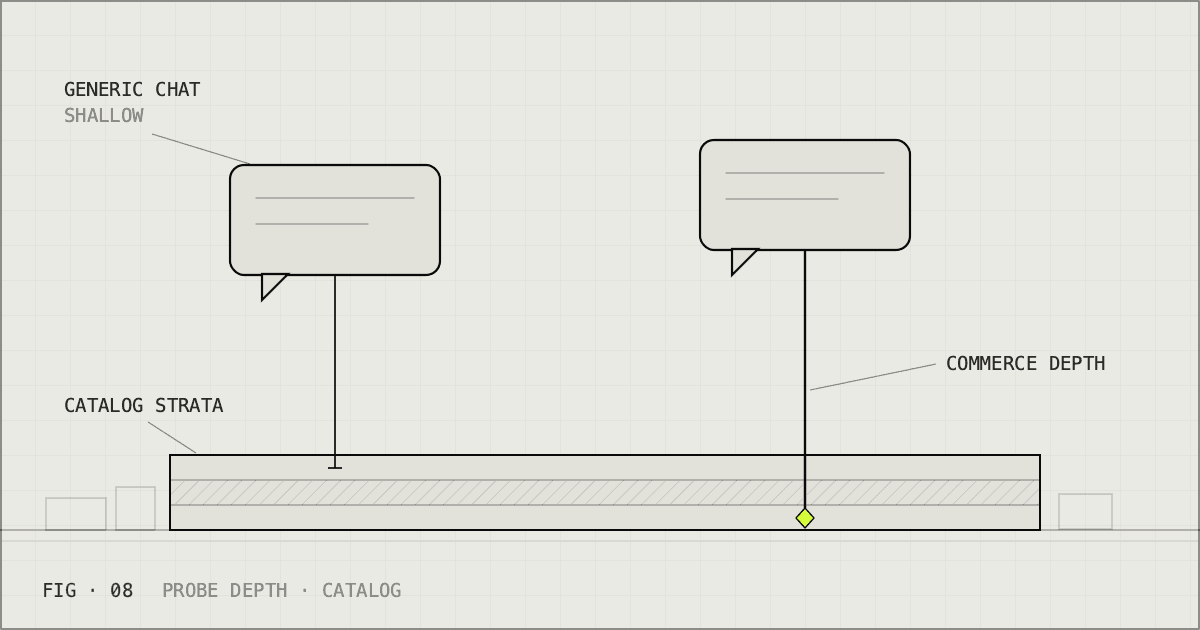
The short version: Tidio and Chatcast are both "AI chat for your store," but they are built to do different jobs. Tidio is a general-purpose customer service platform — live chat, a shared inbox, automation flows, and the Lyro AI agent — that works on almost any website and across email, Messenger, Instagram, and WhatsApp. Chatcast is a commerce-specific AI shopping assistant built for Shopify: it answers from your live catalog and policies using deterministic skills rather than free-form LLM generation, renders products as interactive cards inside the conversation, and adds an agentic-commerce layer — a public MCP server and AI-agent affiliate commissions — that Tidio simply doesn't have.
If your biggest problem is support volume across many channels and you want humans in the loop, Tidio is a strong, mature choice. If your biggest problem is converting shoppers on a Shopify store and being discoverable to AI agents like ChatGPT and Perplexity, Chatcast is built for exactly that.
Here's the honest breakdown.
What is Tidio?
Tidio is a customer service platform that combines live chat, a help desk, automation workflows (called Flows), and an AI agent called Lyro. It has been around since 2014 and reports over 300,000 businesses using the product, including recognizable brands. On the Shopify App Store, the Tidio app holds a 4.7-star rating across more than 1,200 reviews — broad, sustained SMB adoption that few chat tools can match.
Tidio's core strengths:
- Multichannel inbox. Live chat, email, Facebook Messenger, Instagram, and WhatsApp all flow into one shared inbox, so a small team can answer everything in one place.
- Lyro AI agent. Lyro is Tidio's flagship AI. It scrapes your support content and knowledge base, answers common questions automatically, and escalates what it can't handle to human agents. Tidio claims a 67% AI resolution rate and backs it with a money-back guarantee if your rate doesn't reach at least 50%.
- Generous free tier. As of June 2026, Tidio's free plan includes 50 conversations per month at $0 — enough for a small store to evaluate the product properly.
- Ease of setup. Installing the widget, connecting channels, and turning on Lyro is genuinely fast. This is a big part of why Tidio's Shopify reviews skew so positive.
Tidio's pricing, as of June 2026: the free plan covers 50 conversations; Starter begins at $24.17/month (annual billing); Growth starts at $49.17/month with up to 2,000 billable conversations; Plus starts at $749/month; and Premium is custom-priced. Lyro is metered separately — $0.50 per AI conversation, with the first 50 conversations free on any account.
That last point matters more than it first appears, and we'll come back to it.
What is Chatcast?
Chatcast is a brand-trained AI shopping assistant and self-updating FAQ widget for Shopify stores. Where Tidio is a customer service platform that happens to work on ecommerce sites, Chatcast is commerce infrastructure that happens to look like a chat widget.
The architectural difference is the whole story:
- Answers come from your store, not from a language model's imagination. Chatcast answers questions from your live catalog and policies via deterministic skills — structured lookups against real product data, inventory, and policy documents — rather than LLM text generation. When a shopper asks "do you have this in a medium?", the answer comes from your actual Shopify inventory, not from a model's best guess about what your knowledge base probably says.
- Purpose-built intent understanding. Chatcast routes every message through a 66M-parameter intent classifier that runs in 37ms and covers 13 ecommerce intent types. On a benchmark of 12,400 real ecommerce queries, it scored 11 points more accurate than GPT-4o at classifying shopper intent. We wrote up exactly how and why we built it — the short version is that a small model trained on one job beats a giant general model at that job, at a fraction of the latency and cost.
- Commerce-native conversation surfaces. Product recommendations render as inline product cards and full product detail views inside the chat, and conversations are cart-aware — the assistant knows what's in the shopper's cart and can act on it. This is the difference between a chat tool that links to your product page and one that is a shopping surface.
- An agentic-commerce layer. Every Chatcast store gets a public MCP server, which means AI agents — ChatGPT, Claude, Perplexity, and whatever ships next — can query your catalog, FAQs, and policies directly through a structured protocol. On top of that, Chatcast supports agentic affiliate commissions: AI agents that send you paying customers can register, get attributed, and earn a commission you control. This entire layer has no equivalent in Tidio.
- Lead capture and integrations. Chatcast captures leads in conversation and pushes events to your stack via webhook integrations.
Pricing runs from $0 to $199/month, the free plan requires no credit card, and billing goes through Shopify — one invoice, no separate payment setup.
How do Tidio and Chatcast compare side by side?
| Dimension | Tidio | Chatcast |
|---|---|---|
| Core job | Customer service platform: live chat, shared inbox, help desk, automation | AI shopping assistant + self-updating FAQ for Shopify storefronts |
| AI approach | Lyro, a generative AI agent trained on your support content and knowledge base | Deterministic skills over your live catalog and policies, routed by a purpose-built 66M-parameter intent classifier (13 intent types, 37ms) |
| Commerce-specificity | General-purpose; works on any website, with Shopify integration for cart preview and product recommendations | Commerce-only; cart-aware conversations, inline product cards and PDPs in chat, answers grounded in live inventory |
| Pricing model | Plans from $0 to $749+/month, plus $0.50 per Lyro AI conversation (as of June 2026) | $0 to $199/month, no per-conversation AI metering, free plan with no credit card, Shopify billing |
| AI-agent / AI-search readiness | None — Lyro serves visitors on your site and channels | Public MCP server so ChatGPT/Claude/Perplexity can query your catalog, plus agentic affiliate commissions for AI agents |
| Channels | Live chat, email, Messenger, Instagram, WhatsApp — unified inbox (source) | On-site widget on your Shopify storefront, plus AI-agent channels via MCP |
Two things in that table deserve a closer look.
First, the pricing models reward different behaviors. Tidio's per-conversation Lyro pricing means your AI bill scales linearly with how much your AI gets used — at $0.50 per conversation, 2,000 AI conversations a month is an extra $1,000 on top of your plan. That's a reasonable model for support deflection, where every AI conversation replaces a human ticket. It's a strange model for sales, where you want the AI talking to as many shoppers as possible. Chatcast's flat plans mean a busy month costs the same as a quiet one.
Second, the AI-agent row isn't a niche feature — it's a different distribution channel. Shoppers increasingly start product discovery inside AI assistants rather than Google. A chat widget, however good, only helps the visitors who already found your site. An MCP server makes your catalog queryable by the AI agents your next customers are already talking to. If you're new to this shift, our guide to agentic commerce covers it in depth.
When should you choose Tidio?
Genuinely, in several situations:
- You need human live chat with a real team inbox. Tidio's bread and butter is humans answering customers in real time, with AI handling the repetitive layer. Chatcast is an AI-first assistant; if staffed live chat is your primary requirement, Tidio does that job better today.
- You support customers across many channels. If your customer conversations live on Instagram DMs, WhatsApp, Messenger, and email as much as on your website, Tidio's unified multichannel inbox is the right architecture. Chatcast lives on your storefront and in AI-agent channels — it is not a social inbox.
- You're not on Shopify, or run multiple non-commerce sites. Tidio works on practically any website. Chatcast is built for Shopify stores specifically; if your business is a SaaS product, an agency site, or a marketplace presence, Tidio is the more natural fit.
- Support deflection is your main KPI. If you measure success in tickets avoided rather than carts converted, Lyro's model — trained on your help content, guaranteed resolution rate, per-conversation pricing — is coherent and proven. The 67% resolution claim comes with a money-back guarantee, which is more accountability than most vendors offer.
Tidio earned its 300,000+ businesses. None of this comparison should suggest otherwise.
When should you choose Chatcast?
Choose Chatcast when the job is selling, not just servicing:
- You run a Shopify store and conversion is the metric. Chatcast's entire design — cart-aware conversations, inline product cards, recommendations grounded in live inventory — exists to move shoppers from question to checkout, not to close tickets.
- You want answers you can trust on autopilot. Generative AI agents are impressive, but they generate. Chatcast's deterministic skills mean the price, stock status, and return policy a shopper sees come from your store's actual data, every time. For a solo founder or lean team that can't review AI transcripts daily, that guarantee is worth a lot.
- You want to be visible to AI agents, not just human visitors. This is the structural difference. Chatcast's public MCP server makes your catalog discoverable and queryable by ChatGPT, Claude, and Perplexity, and agentic affiliates lets you pay commissions to the AI agents that send you buyers. Tidio has no answer to this category because it isn't trying to — it's a customer service company.
- You want predictable pricing that doesn't penalize engagement. Plans run $0 to $199/month flat, the free plan needs no credit card, and everything bills through Shopify. No per-conversation meter ticking up during your best sales week.
- Your FAQ should maintain itself. Chatcast's FAQ widget updates from your store's policies and content, so the answer to "what's your returns window?" stays correct when your policy changes — without anyone editing a knowledge base.
Frequently asked questions
Is Tidio good for Shopify stores?
Yes — as a customer service tool. Its 4.7-star rating across 1,200+ Shopify reviews reflects real merchant satisfaction with setup, the unified inbox, and Lyro's support automation. The honest caveat is that Tidio is a general-purpose platform with a Shopify integration, not a commerce-native assistant: it can preview carts and recommend products, but its AI answers from your support content rather than executing deterministic lookups against your live catalog, and it does nothing to make your store visible to AI shopping agents.
How is Chatcast's AI different from Lyro?
Lyro is a generative AI agent: it ingests your knowledge base and help content, then generates answers, escalating to humans when it's unsure. Chatcast inverts the architecture — a 66M-parameter classifier identifies the shopper's intent in 37ms, then a deterministic skill executes against live store data: a catalog query, a policy lookup, a cart action. The result is rendered as structured UI (product cards, PDPs) rather than only text. Generation is flexible; determinism is reliable. For support content, flexibility wins. For prices, stock, and policies, reliability wins.
Can I run Tidio and Chatcast together?
Technically yes — they're separate widgets doing separate jobs, and some merchants will want Tidio's human inbox alongside Chatcast's shopping assistant. In practice, two chat launchers on one storefront confuses shoppers, so most stores should pick the tool that matches their primary problem: Tidio if it's multichannel support volume, Chatcast if it's storefront conversion and AI-agent visibility. Chatcast's lead capture and webhook integrations can route conversations into whatever support stack you already run.
The bottom line: Tidio is an excellent general-purpose customer service platform, and if you need a multichannel human-plus-AI support inbox, you should evaluate it seriously. But if you run a Shopify store and want an AI that sells from your live catalog, never invents a price, and makes your products discoverable to the AI agents your customers are already using — that's the job Chatcast was built for.
Start on the free plan — no credit card, billed through Shopify when you upgrade — and see the difference on your own catalog.